

Have you ever finished watching an intense thriller on Netflix, only to open the app the next day and find three more perfect recommendations waiting for you? Or maybe you were walking down the street, tapped a song on Spotify, and wondered how its Discover Weekly playlist seems to know your music taste better than your best friends do?
Welcome to the hidden realm of Data Science in the Wild.
Data science isn’t just about giant spreadsheets, abstract math, or programmers typing away in dark rooms. It is the invisible force running quietly in the background of your smartphone, predicting your habits, guiding your morning commute, and getting a package delivered to your doorstep before you even realize you need it.
Whether you are a 12-year-old curious about how video games and apps work, or a 24-year-old looking to kickstart a career in tech, understanding how real-world algorithms work is like acquiring a superpower. Let’s pull back the curtain and explore how the world’s biggest platforms like Netflix, Spotify, Google Maps, and Amazon use real-time data to shape our daily lives.
1. The Mind Readers: How Netflix and Spotify Predict Your Every Choice
We’ve all experienced the “choice paralysis” of scrolling through hundreds of movies or songs, unable to pick one. To keep you engaged, platforms like Netflix and Spotify don’t just host content, they curate an entire digital world tailored specifically to your personality.
The Magic Behind Netflix: Matrix Factorization & Visual Personalization
When you open Netflix, your homepage looks entirely different from your friend’s homepage even if you both watch similar genres. Netflix achieves this using advanced Recommendation Algorithms.
Collaborative Filtering and Matrix Factorization
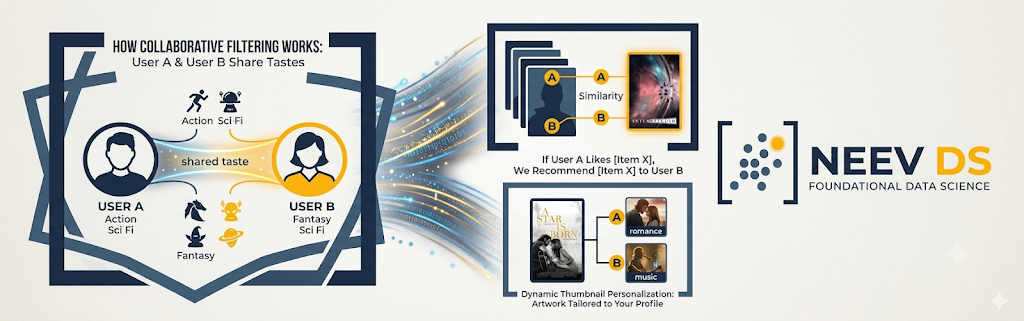
At its core, Netflix uses Collaborative Filtering. Instead of analyzing just what a movie is about, the algorithm looks at behavioral patterns across hundreds of millions of users. If User A and User B both enjoyed Stranger Things, Wednesday, and Cyberpunk, and User A loved a new sci-fi movie that User B hasn’t seen yet, Netflix will recommend that movie to User B.
Mathematically, this relies on a machine learning technique called Matrix Factorization. Researchers Koren, Bell, and Volinsky, who won the famous $1,000,000 Netflix Prize demonstrated that user-item interaction matrices can be decomposed into low-rank latent factor spaces. This allows algorithms to uncover hidden preferences, such as a user’s subtle preference for dark synth-wave soundtracks or 90-minute runtime action comedies.
Dynamic Artwork Personalization
Did you know that the thumbnail image (artwork) you see for a show on Netflix is generated specifically for you?
- If you watch a lot of romance movies, the thumbnail for a movie might show the two lead actors sharing a sweet moment.
- If you prefer comedy, the thumbnail for that same movie might feature a popular side-character giving a funny facial expression.
Netflix uses Multi-Armed Bandit Algorithms to test thousands of image variations in real-time, instantly learning which image triggers the highest click-through rate (CTR) for your specific profile.
Decoding Spotify: Echo Nest, Audio Analysis, and NLP
Spotify’s algorithm delivers tailored playlists like Discover Weekly and Daily Drive using a three-pronged approach:
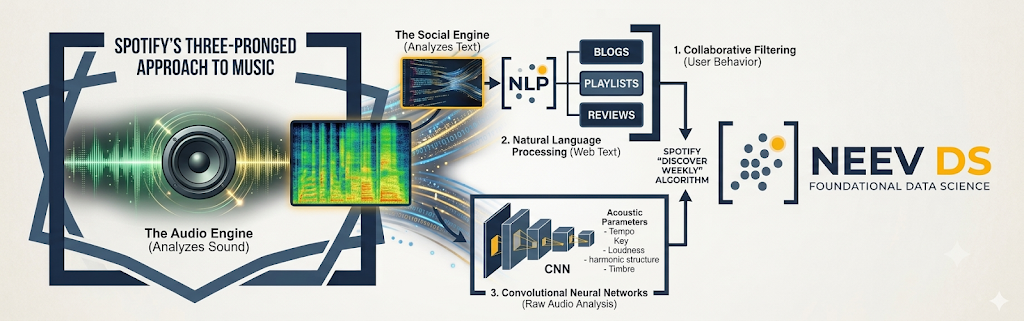
- Collaborative Filtering: Similar to Netflix, it analyzes your listening history alongside millions of other playlists to identify missing tracks you might love.
- Natural Language Processing (NLP): Spotify constantly scrapes the internet music blogs, tweets, music reviews, and track descriptions to understand how people describe specific songs and artists. If words like “upbeat,” “workout,” or “chill study vibes” appear frequently around a track, it gets tagged accordingly.
- Raw Audio Signal Analysis: What if a song is brand new and has zero listeners or online reviews? Spotify uses Convolutional Neural Networks (CNNs) to process raw audio files, analyzing time-frequency representations (spectrograms) to detect acoustic parameters like tempo, key, loudness, harmonic structure, and timbre.
2. The Real-Time Pathfinder: How Google Maps Estimates Your ETA and Beats Traffic
Have you ever wondered how Google Maps knows that a traffic jam started just 500 meters ahead of you, predicting your arrival time down to the exact minute?
Navigating a dynamic, ever-changing physical world requires massive real-time data collection and high-level spatial graph calculations.
How Google Maps Detects Traffic Congestion
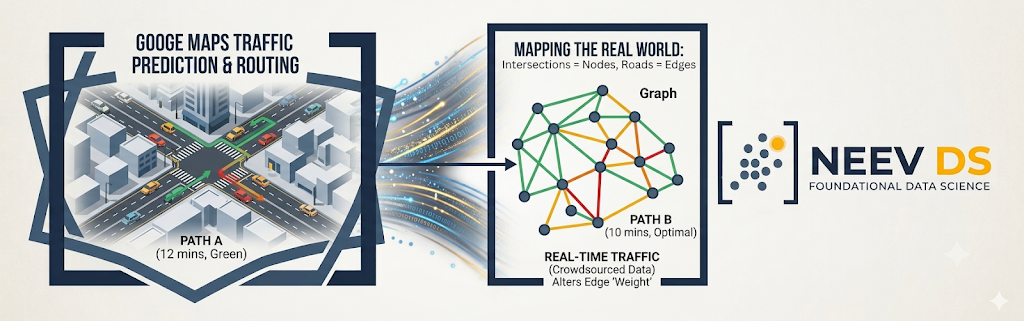
Google Maps doesn’t rely on cameras mounted on streetlights. Instead, it relies on crowdsourced sensor data from hundreds of millions of smartphones around the globe.
When you drive or ride with Google Maps active (or even running in the background), your phone anonymously transmits telemetry data back to Google’s servers:
- Location (GPS coordinates)
- Speed (rate of displacement over time)
- Direction of travel
If dozens of smartphones on a specific stretch of a highway suddenly slow down from 60 mph to 10 mph, the algorithm immediately identifies a traffic anomaly and turns that road segment red on the map.
Predicting Your ETA: Graph Algorithms and Graph Neural Networks (GNNs)
Calculating the shortest path between two points on a map is a classic problem in computer science. Historically, platforms used Dijkstra’s Algorithm or the A Search Algorithm* to find the shortest route along a network of nodes (intersections) and edges (roads).
However, finding the fastest route in the real world is far more complex than finding the shortest distance, because traffic conditions change rapidly.
To solve this, DeepMind collaborated with Google Maps to implement Graph Neural Networks (GNNs). GNNs divide road networks into subgraphs and process historical traffic trends alongside real-time variables (such as weather conditions, road construction, time of day, and historical speeds for a specific Tuesday morning).
By leveraging GNNs, Google Maps reduced predictive ETA errors significantly, dynamically re-routing drivers away from congestion before they even reach the traffic bottleneck.
3. The Hyper-Speed Supply Chain: How Amazon Delivers Packages in Under 24 Hours
Ordering a gadget online at 10:00 PM and receiving it on your doorstep by 10:00 AM the next morning feels like magic. But behind that Amazon Prime package is one of the most advanced, data-driven logistical operations in human history.
Predictive Analytics & “Anticipatory Shipping”
Amazon’s supply chain optimization begins before you place an order.
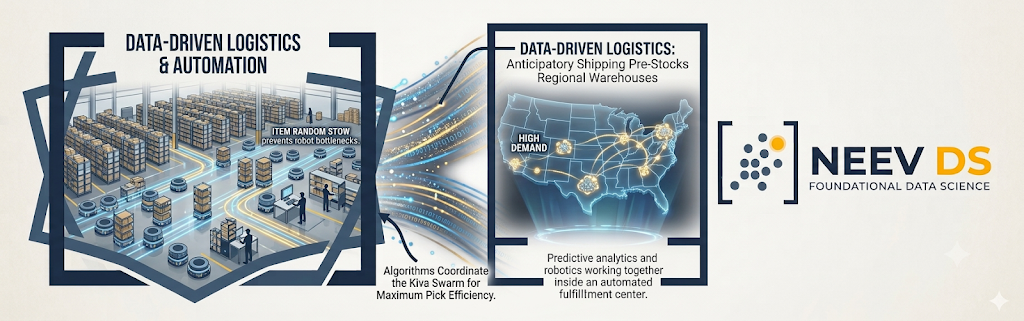
Through a process known as Anticipatory Shipping (a technology patented by Amazon), machine learning models analyze search trends, wishlist items, cart activity, and regional buying histories to predict what products will be bought, by whom, and in what geographic areas.
How It Works:
- If data indicates that customers in a specific city buy a certain gaming mouse during late-night gaming sales, Amazon pre-ships inventory of that mouse to a local Fulfillment Center nearby.
- When you finally click “Buy Now,” the product isn’t traveling across the country—it is already waiting a few miles away.
Warehouse Automation and Kiva Robotics
Inside Amazon’s mega-fulfillment centers, data science directs teams of automated Kiva Robots. Instead of human workers walking miles up and down aisles searching for items, algorithms direct drive units to lift entire inventory shelves and deliver them directly to human pickers.
To prevent bottlenecks, algorithms continuously optimize:
- Item Placement (Random Stow): Counterintuitively, Amazon doesn’t group all identical items together. Similar items are distributed across various shelves so multiple robots can access the same product category simultaneously without causing “traffic jams” in the warehouse aisles.
- Pick-Path Optimization: Algorithms calculate the most efficient path for both human workers and autonomous robots, minimizing travel time per item pick down to the millisecond.
The Last-Mile Delivery Problem
The final leg of a package’s journey—from the local delivery hub to your front door—is known as the Last-Mile Delivery. It is historically the most expensive and complex part of the supply chain due to urban traffic, parking challenges, and non-linear routes.
Amazon solves the Last-Mile problem using advanced variants of the Vehicle Routing Problem (VRP). Algorithms run dynamic optimization models that calculate the best order of delivery stops, taking into account vehicle capacity, delivery time windows, turn restrictions, and live traffic data.
4. Key Takeaways: Comparing Everyday Data Science Systems
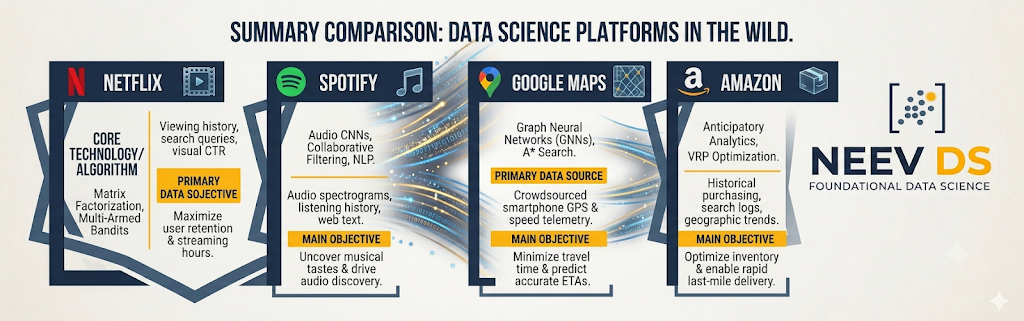
To help visualize how these platforms leverage data differently depending on their goals, here is a breakdown of their primary architectures:
| Platform | Core Tech / Algorithm | Primary Data Source | Main Objective |
| Netflix | Matrix Factorization, Multi-Armed Bandits | Viewing history, search queries, visual CTR | Maximize user retention & streaming hours |
| Spotify | Audio CNNs, Collaborative Filtering, NLP | Audio spectrograms, listening history, web text | Uncover musical tastes & drive audio discovery |
| Google Maps | Graph Neural Networks (GNNs), A* Search | Crowdsourced smartphone GPS & speed telemetry | Minimize travel time & predict accurate ETAs |
| Amazon | Anticipatory Analytics, VRP Optimization | Historical purchasing, search logs, geographic trends | Optimize inventory & enable rapid last-mile delivery |
5. References and Scientific Foundations
To see how these everyday applications are rooted in computer science literature, explore these fundamental research papers:
- Matrix Factorization Techniques for Recommender Systems
- Authors: Yehuda Koren, Robert Bell, and Chris Volinsky (2009).
- Publication: IEEE Computer Society (Computer, Vol. 42, No. 8).
- Key Insight: Outlines how latent factor models and matrix factorization powered the winning algorithms of the Netflix Prize.
- Deep Content-Based Music Recommendation
- Authors: Aäron van den Oord, Sander Dieleman, and Benjamin Schrauwen (2013).
- Publication: Advances in Neural Information Processing Systems (NeurIPS 2013).
- Key Insight: Demonstrates how Convolutional Neural Networks (CNNs) can be trained on raw audio spectrograms to predict user music preferences without relying on metadata.
- Eta Prediction with Graph Neural Networks in Google Maps
- Authors: Austin Derrow-Pinney, et al. / DeepMind & Google Maps Team (2020/2021).
- Publication: DeepMind Research Publications.
- Key Insight: Details how structure-aware Graph Neural Networks (GNNs) reduced suprasegmental ETA mispredictions by up to 50% across major global cities.
- The Vehicle Routing Problem: Exact and Approximation Algorithms
- Authors: Paolo Toth and Daniele Vigo (2002).
- Publication: SIAM Monographs on Mathematical Modeling and Computation.
- Key Insight: Provides the foundational mathematical frameworks used in modern logistics networks (like Amazon) to optimize last-mile delivery routes.
Conclusion: Neev’s Perspective on Our Data-Driven Future
When we look at platforms like Netflix, Spotify, Google Maps, and Amazon, it is easy to view them simply as convenient tools. But from my perspective, they represent a fundamental shift in how humanity interacts with technology.
Data science is no longer confined to academic laboratories or high-tech research centers—it lives inside our pockets, shapes our morning routines, curates our personal tastes, and drives the global economy. Every click, every tap, every skipped track, and every pause you make creates a digital breadcrumb. When millions of these breadcrumbs come together, algorithms turn chaotic noise into meaningful insights.
For our generation—those of us navigating our teens and early twenties—understanding data science is more than just learning how to code or analyze statistics. It’s about building digital literacy and recognizing the hidden architectures that influence our choices every day.
Whether you aspire to become a data scientist, an engineer, an entrepreneur, or simply a conscious digital citizen, mastering the concepts behind these algorithms gives you a seat at the table. Technology shouldn’t be a black box that thinks for us; it should be a tool that we understand, shape, and steer toward solving real-world challenges.
The algorithms of today are already predicting what you’ll watch, listen to, and buy next. The real question is: What will you build with data science tomorrow?
Hi, this is a comment.
To get started with moderating, editing, and deleting comments, please visit the Comments screen in the dashboard.
Commenter avatars come from Gravatar.